
Goat Trails
by Ryan Masters
Nov. 7, 2014—We are not naked, which is a little disappointing, but it sure is pretty out. Overhead, the full moon looks nailed to the night sky like the crown of a skull. It casts a pearly glow over Seabright Beach. I am standing in a group of pagans and our high priest, a nattily dressed goblin named Birch, is drawing a circle in the sand around us. A guitar is draped across his back.
The bonfire at the center of our ring illuminates two-dozen practitioners of witchcraft. I would say they look the part, but just about everyone in Santa Cruz does—so just normal local folk. Birch finishes “casting” the circle. This, he informs us, creates a sacred space that cannot be entered or departed during the ritual. Such an event would require a “cutting,” which sounds ominous so I decide to remain in the circle. Clearly paganism does not require some opulent temple or stuffy church. We’ve got the sand beneath our feet and the stars overhead. I can dig it.
Birch unslings his guitar and breaks into an earthy hymn. Some of my fellow pagans know the words. As a group, we turn to hail each of the four directions. This bit is known as “calling the quarters.” Bathed in silvery light, we invoke the energy of goddesses, tides, and ultimately, the full moon. Witches consider it the most essential heavenly body for their magic. They cast spells in accord with her cycles as she waxes and wanes back and forth from maiden to mother to crone. From what I’m told, this evening’s moon is a particularly powerful conduit for pagan invocations.
Tonight is the Frost Moon—alternately known as the Hunter’s Moon or the Beaver Moon. I know this because earlier in the evening I went on a guided sunset stroll along this same beach with patrons of the Santa Cruz Museum of Natural History. As the sunset transformed the sky into a striated masterpiece of Georgia O’Keefe pastels, our guide explained the moon’s gravitational role upon the tides—how it draws and pushes all the water on the planet back and forth like a giant, sloshing bathtub.
During our leisurely mosey to the harbor mouth, we learned that the moon is a massive chunk of ancient earth. When an asteroid the size of Mars collided with our planet 4.4 billion years ago, it fractured off and floated 238,900 miles into space before locking into its current gravitational orbit. That is the scientific community’s explanation, but there are almost as many origin stories about the moon as there are cultures.
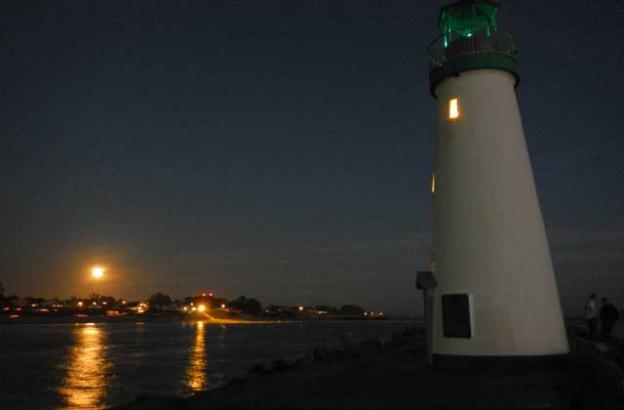
By the time we reached the lighthouse, the swollen moon was peeking over the rooftops of Santa Cruz’s East Side. Our natural history guide summarized the Maidu’s version of its origins: Moon and Sun slept in a large stone house at the edge of the world. The animals of the world were tired of living in the dark so they sent Angleworm and Gopher to rouse the lazy siblings. Angleworm drilled through the wall of the stone house and Gopher released a swarm of fleas into the hole. Plagued by the invasion of biting insects, Moon and Sun escaped into the sky and have been there ever since.
As we digested the Maidu story, the moon rose as if cranked into the sky by some ancient mechanism of gears and spinning wheels. It looked ginormous. No one’s exactly sure why the moon appears far larger on the horizon than it does is in the sky. It’s an optical illusion that has occupied great minds since ancient times. I say let some mysteries remain mysteries.
Gaining altitude, the moon shimmered in the harbor waters. Its light wavered and bobbed in the wakes of passing boats, reminding me of my favorite Chinese poet, the great and frequently drunken Li Po (701-762 A.D.), who is said to have died while trying to catch the moon’s reflection in the waters of a lake. For Li Po, the moon was a symbol of permanence in an ever-changing world. “The people of today cannot see the moon of ancient times,” he wrote. “But today’s moon once shone up on the ancients.”
Two hours later, I am among the pagans thinking about my ancestors—people who inhabited the lands now known as Scandinavia and the British Isles. Chances are they ritually invoked the moon in a way that bore some similarity to what we’re doing now.
“Witches like to burn things,” Birch says. “So that’s what we’re going to do.”
He hands us each a slip of paper to write down our “petition” to the Moon Goddess Aradia. “Avoid negatives,” he instructs. “No ‘no’s. Where the attention goes, the energy flows, folks.” His advice reminds me of something an Egyptian sorceress once told me: The universe’s only answer is ‘yes.’ We scribble down our positive prayers of divine intervention and lift them overhead in our left hands. We close our right eyes and block the moon with the slip of paper as Birch invokes the Goddess. Then we burn them in the bonfire. Our petitions disappear in wisps of smoke up into the lunar light.
The Moon Goddess Aradia appears to have gained favor among pagans thanks to an American folklorist named Charles Godfrey Leland who published a book called Aradia, or the Gospel of the Witches in 1899. Leland claimed his book was a religious text produced by a coven of Tuscan witches. It begins with the tale of Aradia’s birth to the Roman Goddess Diana and…wait for it…Lucifer! So there’s that. Of course, in the pagan ontology, Satan is a far more positive and virtuous force than his Judeo-Christian counterpart. But still. I’m going to go out on a limb here and guess that this aspect of the ritual is probably a deal-breaker for most people.
Yet despite his rather nefarious-looking fedora, Birch has promised us that this pagan moon rite is a good vibes and love energy deal. Fortunately, I’m not too hung up on the Lucifer thing. There are as many metaphors for God as there are stories about the moon’s origins. It’s human nature to assign a symbol to represent something as impossible to fully grasp and explain as God consciousness. In my mind, that’s what poetry is for. As a result, my higher power comes in many shapes and forms, but they all represent the same thing. And tonight, the Moon Goddess Aradia stars in that role.
As the ritual winds down, Birch recites a passage from the first chapter of Leland’s Gospel of Witches. He calls it “the closest thing we have to a holy text in paganism.” In it, Aradia has descended to Earth on the behest of her mother, Diana, and is instructing humans how to be witches and rise up against the oppressive Roman Catholic Church—which, at the time, was doing its best to destroy paganism and its practitioners:
"When I shall have departed from this world, whenever ye have need of anything, once in the month, and when the moon is full, ye shall assemble in some desert place, or in a forest all together join to adore the potent spirit of your queen, my mother, great Diana. She who fain would learn all sorcery yet has not won its deepest secrets, then my mother will teach her, in truth all things as yet unknown. And ye shall all be freed from slavery, and so ye shall be free in everything; and as the sign that ye are truly free, ye shall be naked in your rites, both men and women also: this shall last until the last of your oppressors shall be dead."
Damn it, I knew we were supposed to be naked.
The next full moon ritual is Dec. 6. To register for classes in witchcraft with Birch or find a calendar of pagan events, visit www.sacredgrovesantacruz.com or stop by The Sacred Grove in downtown Santa Cruz.
For more information about the Santa Cruz Museum of Natural History’s sunset strolls or other events, visit santacruzmuseum.org.
Goat Trails is a weekly column by Ryan Masters.
Category:


