
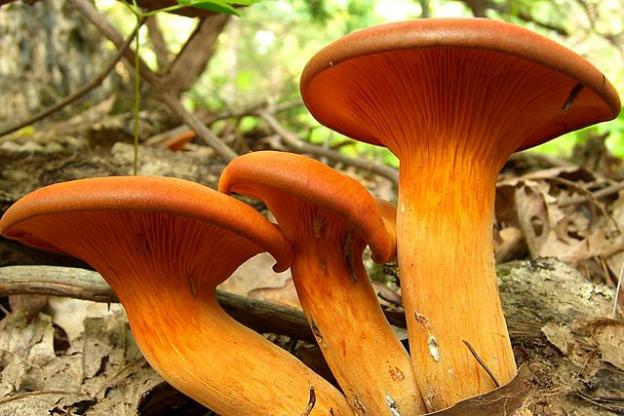
A Parks Interpreter gives the lowdown on the mushrooms found at Henry Cowell Redwoods State Park and explains the wonder of "winter's fruit."
by Rose Nelson
Jan. 7, 2015—When winter comes to the mountains, it can be tempting to stay inside with a good book, warm drink and to listen to the movement of water around you. Yet be advised, those who adventure in the rain are able to witness the fast-changing understory of the forests. The dust settles, the mosses perk up and the fruit of winter peek out from their dormant state. Becoming a mycologist (one who studies fungus) can not only take you on adventures, but can also bring you closer to understanding your surrounding environment.
Mushrooms have been ignitions for curiosity for centuries. Humans have used them for food, medicine, religious ceremony, and even poisoning enemies. They are so much more that, though—they are a vital and complex part of the ecosystem. Some fungi, along with bacteria, insects and slugs, are nature’s recyclers. Saprophytic fungi feed on dead organic matter and recycle the nutrients back into the environment. Mycorrhizal fungi form symbiotic relationships with rootlets of plants and there is a mutually beneficial exchange of nutrients. The last group is the rare Parasitic fungi, which feed on living organisms. These three different types of fungi produce a myriad of fruiting displays that we know as mushrooms.
The mushrooms we see above ground are actually the fruits of the hidden fungus organism. This organism consists of an intricate network of filaments called the mycelium. The mycelium grows in soil, on wood and leaves, beneath the bark of dead trees and within the heartwood of living trees. The mushroom begins as a small dot on the mycelium, and then grows bigger as the fruit develops. The function of the fruiting bodies is, of course, to reproduce the species. Fungi do this by releasing millions of spores that travel via biotic and abiotic methods alike. The spores germinate to create the mycelium and the circle continues.
Here in Santa Cruz County, we have more than 2,000 species of mushrooms. Henry Cowell boasts a variety of species, from beautiful Oysters and Lion’s Mane to Jack O’Lanterns and Death Caps. They bring about curiosity and wonder to the park that keep visitors excited in the rainy months. However, it is always a struggle to keep mushroom hunters from picking in the park!
I look forward to learning about new fungi as it pops up through the various conditions of the winter months. And I am excited for the 2015 Fungus Fair at Louden Nelson Community Center from January 9th to January 11th!!
Rose Nelson is a Parks Interpreter at Henry Cowell Redwoods State Park.
RELATED ARTICLES
My Fair Fungus
The 2015 Fungus Fair
Category:


