




Read on if you are interested in the Big Sur Pfeiffer Ridge Fire, forest fire, fire ecology, ecological succession, plants after forest fire
by Desiree Loggins
Jan. 2, 2014—When considering our developed and admittedly crowded world, it can be difficult to conceive of how wildfire would do us any good. There is a visceral twang of anxiety that shoots up a Californian’s spine when witnessing familiar parks in Big Sur or anywhere else light up in flames, as we did on Dec. 15 when the Big Sur Pfeiffer Ridge Fire broke out.
See Pfeiffer Ridge resident Jeff Mallory's stunning photos and account here.
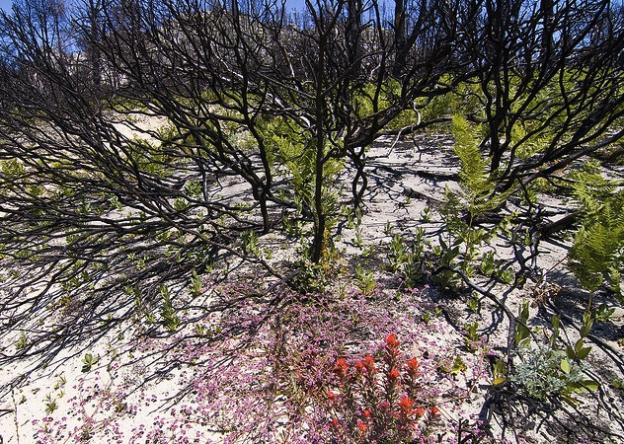
The destruction fire causes is widely associated with charred landscapes devoid of life and beyond recovery, but we should learn to have more faith in the deceptively destructive natural processes that have long been shaping our biosphere. After the initial violence of wildfire subsides, the scorched earth is given a parting gift of nutrient-rich ash and enough sunlight to facilitate its regeneration. When a certain ecological disturbance wipes a landscape clean, the surviving seed bank dictates which plant species will recolonize the area. This form of post-burn renewal is called ecological succession and happens in two parts.
Primary Succession: commonly associated with bare rock or the immediate result of some ecological disturbance. In this stage you may see early successional plant species that are generally what ecologists call r-selected; annual wildflowers like yellow monkey flower (Mimulus guttatus) and varieties of lupine. However beautiful, these early pioneers eventually die back and their biomass rejuvenates the soil with nitrogen and phosphorus, providing nutrients for longer lived and hardier species to exploit.
Secondary succession: it might look more familiar to you, as it usually contains species that previously made up the older plant community. This phase can take hundreds of years. Imagine sitting in a pile of rubble and waiting for a delicate lodge pole pine (Pinus contorta) sapling to mature.
Succession aside, California is home to many dynamic ecosystems that rely on fire disturbance regimes for reproduction and to facilitate the colonization of new areas. Allow me to reintroduce you to several charismatic plant species that have adapted to fires in our local grasslands, chaparral and conifer ecotypes.
Ecological Succession and the California Survivors
Grasslands: local grasslands will include common species like blue wild rye (Elymus glaucus) and California’s state grass, purple needle grass (Stipa pulchra). These perennial bunchgrasses and their relatives in the plant family, Poaceae, have adapted basal meristems; that is, plant tissue where growth occurs. The same mechanism that allows grass to grow back after being grazed by livestock or cut with a lawnmower protects these native grasses from being decimated by fire.
Chaparral: characterized by a semi-arid climate, drought tolerant shrubs, and sandy serpentine soils, the chaparral biome houses a stunning variety of manzanita (Arctostaphylos), which have developed an equally impressive disturbance adaptation called a lignotuber. These are specialized burl-like organs at the base of the shrub that shelter numerous dormant buds which shoot after encountering disturbance from storms or fire. The coast redwood (sequoia sempervirens) of conifer forests also has this adaptation to disturbance. Plants that carry lignotubers are often early successional species. Additionally, ceanothus—found both in chaparral and in urban gardens—enhance the intensity of fires with the resin that coats their leaves. The plant developed flammable resins to promote the germination of its seeds, which need high temperatures to be released from their pods and also to germinate.
Read Ten Amazing Facts About Redwoods
Coniferous forest: evergreen or deciduous forests predominated by cone-bearing trees. These forests are home to the beloved coast redwood. The species ensures a long life in a turbulent world with lignotubers full of buds and also by shedding its lower branches to protect its canopy and the surrounding tree tops from fire. Other coniferous species like the knob cone pine (pinus attenuata) and the ponderosa pine (pinus ponderosa) also have this habit. These species have cones that are specialized to open when under extreme temperatures. You can see this effect for yourself by throwing a few collected cones into a campfire and waiting for the scales to slowly separate, revealing the seeds beneath them. During an intense burn these trees sound off like popcorn poppers, spewing seeds in every direction.
Fires seem to smolder through the most serene wilderness areas with unnecessary vigor, but many plant species depend on and even welcome this chaotic force into their communities. If you find yourself surrounded by the ashes of once familiar flora, be sure to look to the soil. This may be one of the rare instances that, without irony, death brings life.
Desiree Loggins is a UCSC environmental studies graduate and a park aide for the Friends of Santa Cruz State Parks. This is her first column for Hilltromper.
Category:


