
by Andrew Juiliano
Four hikers laugh their way along the Pine Ridge Trail, far above the Big Sur River raging thousands of feet below. The jovial tone changes as they round a corner to discover the body of a group member who ran ahead five minutes earlier. Surveying the scene, one hiker approaches the victim and kneels down next to the motionless body.
“He’s not breathing and I can’t feel a pulse,” she says. She directs one group member to radio for help and prompts the other two to prepare for CPR. Under the scorching midday sun, beads of sweat form on her forehead, and as she leans over to deliver the initial chest compressions a salty drop falls on her unresponsive patient. As the sweat hits his face, he squirms and lets out a life-affirming “YICK!” The group members freeze for a split second, then relax and chuckle as John Taussig, the founder of Backcountry Medical Guides, steps in with a grin and embraces his pedagogical preference, the “teachable moment.”
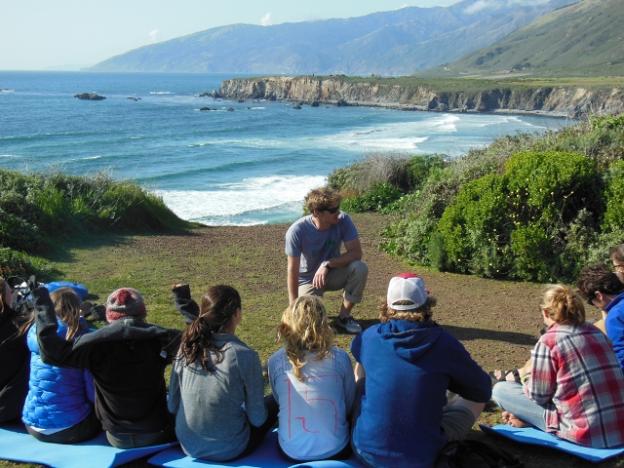
Founded in 2010, Backcountry Medical Guides aims to deliver immersion training, scenario-intensive medical programs to small groups—and incorporating class members into these situations is commonplace.
Backcountry Medical Guides’ interactive approach to wilderness medical education springs from Taussig’s long experience in emergency medical services (EMS). The founder wears a perpetual grin on his sun-freckled face, his broad shoulders and 6’ 2” frame a testament to the family genes (his father played NCAA hockey). Taussig’s hands are rough and weathered from his EMS career, which began in 2000 when he got a job driving an ambulance in Yellowstone National Park. He supplemented his neuroscience studies at Montana State University working ski patrol at Big Sky Ski Resort. Those 13 years of remote medical experience evolved into his current gig as a flight paramedic medic for Mercy Air in Monterey and Fresno counties.
Treating the victims of backcountry folly inspired Taussig to promote a more responsible brand of outdoor enthusiast. “It started in the galley of my sailboat and in the back of an ambulance,” Taussig explains. “I wanted to provide adventure-based medical education really, really well, and never falter from that goal. BMG attempts to do wilderness medicine education right.”
To provide adequate attention to all students, BMG’s pupil-to-instructor ratio remains small at 5:1. He explains that this intimate interaction allows courses to “go further and be more in-depth, with super-active hands-on learning in the backcountry.
“Ultimately we aim for an adventure-based curriculum that is within the context of the regular outdoor enthusiast.”
This adventure-based curriculum lands students in diverse learning environments across California. BMG offers everything from Wilderness First Aid courses for kids in the Santa Cruz Harbor to weeklong Wilderness First Responder Courses in Big Sur and Lake Tahoe. The remote medical training doesn’t stop with the basics, as Taussig also leads programs in Advanced Wilderness Life Support—a three-day course focusing on remote medical skills for nurses and physicians. As the programs grow, so does professional involvement: BMG’s team consists of 17 instructors, including six physicians.
Each small group that ventures into the backcountry with BMG experiences Taussig’s philosophy of a safer backcountry-bound population. He explains, “The hundreds of people we train help create a more capable backcountry community with better-prepared outdoor enthusiasts.”
Backcountry Medical Guides is offering a number of upcoming courses. To register, email info@backcountrymedicalguides.com or call 831.295.8336.
Wilderness First Aid
Oct. 19-20, 2013 – Santa Cruz
Nov. 2-3, 2013 – Carmel Valley
$215
Wilderness First Aid for Kids
Nov. 2-3, 2013 – Carmel Valley
$114
Advanced Wilderness Life Support
Nov. 15-17 – Big Sur
$495-695
Sartech III- Introduction to Search and Rescue (ISAR)
Dec. 6-7, 2013 – Santa Cruz Yacht Harbor
Non-Member $99.00, Member $135.00
Category:


