
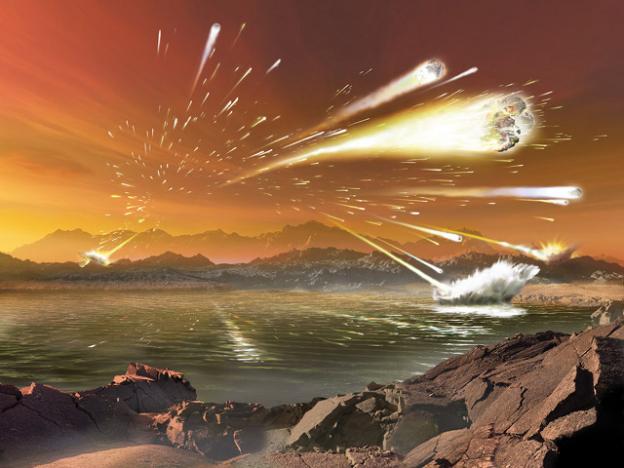
continued from The New Big Bang Theory Illustration by Dana Berry
I went to Boulder, Colorado, home of the Southwest Research Institute, a planetary science research facility that does a lot of theoretical work about the origins of planets, satellites and asteroids. The director of the mission to Pluto, which is called New Horizons and will encounter Pluto in two years, he works there. When I do interviews for pieces like this, I request a lot of time. This is not a 45-minute conversation. The main person, Hal Levison, who was the central character in this story, I spent about five hours with him and a couple hours with many of the other sources there. A lot of them ended up not in the article. A lot of the conversations I had just didn’t end up in the piece because there wasn’t room. That was just to be with them, in person. When you’re with them in the lab, the interviews are far richer. National Geographic has a budget to send you anywhere you want to go.
I spent a few days in Seattle at the University of Washington. The leader of the Stardust mission, which was a NASA mission to bring comet particles back to Earth, works there, and a lot of the particles have been studied in their lab with an electron microscope. I wanted to see that firsthand, and that became the opening scene in the article, with the speck of dust being magnified 900,000 times. That was a profoundly moving experience for me. Because, as the story suggests, when you’re looking at a particle like that, you’re quite literally staring back at the birth of the solar system. This is the primordial stuff out of which everything was made, everything in the solar system.
Could you describe the feeling of looking at the space dust?
I’ve had a few moments in science reporting that I’ve just felt enormously privileged to see something, and that was one of them. It’s profound because it’s us. It’s us 4.55 billion years ago. The reason I started the article with it is that the specks are telling a story. The story is: We were born close to the sun and we were hurled to the other regions of the solar system violently.
They didn’t know that before. They assumed comets were these quiet little fluffballs of ice and dust that gathered out in the remote regions of the solar system. And if they did form like that, you wouldn’t be seeing any of these hardened little rocks. These are specks of incredibly dense metal in the middle of a comet that shouldn’t be there. These were forged in the blast furnace. That’s why the story starts with this scene of the solar system turning itself inside out to set the stage for changing our conception of what the solar system was. It was not this quietly evolving familiar, comfortable place. It was wild from the very beginning.
What are your favorite experiences from your work?
I will, but before I forget I want to say that the other really important interview I did for this story, which helped set the framework for a lot of the article, was here in Santa Cruz, with Greg Laughlin, professor of astronomy at UCSC. He was invaluable in helping me understand the narrative and the historical development of solar system dynamics, and also the framework for what might happen to the solar system in the future. That basically came from him. He’s been writing about this for years himself. He’s very eloquent, he does a fantastic interview, and that was invaluable.
One of the most special moments I’ve had was on the summit of Mauna Kea in Hawaii, where they have major observatories like the Keck Observatory. I was up there at night reporting an article for Smithsonian about the black hole at the center of the Milky Way. I got to see the laser adaptive optics system in action. Adaptive optics is now on every major observatory. But Keck was one of the first ones to do it using laser beams. They don’t allow people up there at night unless they’re working. It’s not a tourist thing. You can see the laser beam from other parts of the mountain. But it’s really only if you are standing outside the dome at an altitude of nearly 14,000 feet in the middle of the night and they turn on the laser beam, and it really hits you. That was also an extraordinarily emotional moment for me. It’s this brand new technology. I was immediately struck by the irony of it. Astronomers always want the sky to be as dark as possible. They’re always trying to eliminate stray sources of light. Yet now, they’re intentionally shining a laser beam exactly where they want to look. There was double irony for this story because they were studying a black hole. They were casting light into the sky to study the darkest thing in the universe. As soon as I saw that, as soon as I had that moment at the top of the mountain, I knew that I had to convey that in some way.


