



by Brendan Bane
The peregrine falcon (Falco peregrinus) is both the fastest animal on the planet and the most widespread of raptors. But this bird of prey wasn’t always prevalent—once nearly lost to DDT during the 1960s and 70s, peregrine falcons have recovered spectacularly and now grace skies across all landmasses except New Zealand and frigid zones.
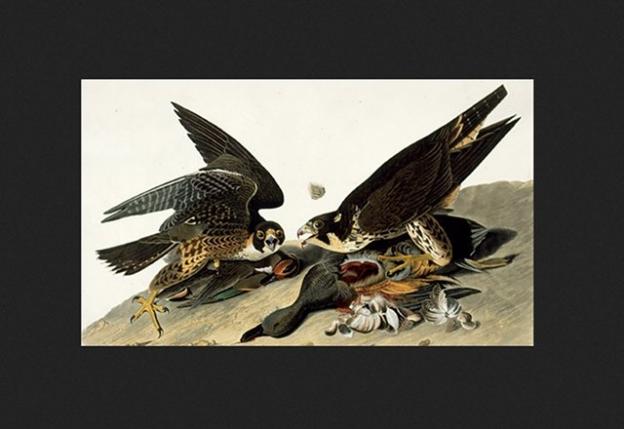
With wings and heads draped in dark tones ranging from chestnut brown to ashen blue, and clean white chests, the peregrine is a crow-sized bird with a wingspan between 2 and 4 feet. Beaks are light orange, dipped in rich black, and culminate in the signature raptor hook.
Sharp beaks, razor talons, and sickle-shaped wings (“Falco” stems from the Latin “falx,” meaning sickle) are the physiological weaponry which equip the peregrine as a hunting specialist. As avivores, they almost exclusively consume birds.
Peregrine falcons prowl the skies at staggering heights. When a lowly pigeon draws near, the falcon drops suddenly, initiating its dive attack. At speeds of up to 242 miles per hour (well over 2.5 times that of a maxed-out cheetah), the bird pounces midair onto the pigeon’s wing, crippling it instantaneously. Once the pigeon is grounded, the peregrine lands and proceeds to shred and lacerate, reducing the pigeon to mere feathers and feet.
But peregrines have not evolved to become the fastest animals on the planet without special adaptations. After all, the drop in air pressure and blasting winds are enough to damage most animal tissues. The peregrine falcon, however, has evolved special nostril nodules, which deflect airflow around its beak, thus dampening the effects of rapidly changing air pressure. They also have special third eyelids (much like those in sharks and reptiles), which shield their eyes while diving.
Birders have observed pairs nesting atop skyscrapers as well as cliff faces. Courtship behavior is elaborate, with embellished spins, spirals, and swoops. Males even pass off food, midair, in a flying trapezeless maneuver, where females fly upside down to accept mangled pigeons.
Pesticide use once nearly eliminated the peregrine altogether. DDT poisoned the falcon’s fat tissues and thinned its eggshells. Captive breeding programs and legislation facilitated the birds’ recovery, and now the UK alone boasts over 1,400 breeding pairs.
Category:


