
by Erin Loury
June 7, 2013—I spent a Saturday afternoon this spring crisscrossing the trails of Nisene Marks State Park, intent on a walk-in-the-woods-turned-treasure hunt. I was in search of a specific quarry, but half an hour in, it looked like I might be skunked—by a tree. My friend and I were just at the point of turning around when we spotted our target among the redwoods and maples. I plucked a slender leaf, crushed it between my fingers, and inhaled its spicy scent. Bingo. A bay tree.
We’d come to the forest as part of a massive citizen science effort called a SOD Blitz, designed to map the spread of a plant disease called sudden oak death around northern California. The SOD Blitz is the brainchild of researchers at UC Berkeley, and it mobilizes people to explore nature and their neighborhoods while gathering some valuable scientific information to boot.
Having written a story about sudden oak death last spring while studying at UC Santa Cruz, and having shadowed SOD Blitz volunteers around Berkeley to record a podcast of the event, I get a little more jazzed about this plant disease than the average person. This year, I was excited to hunt down sudden oak death in my own back yard. I wanted to put my state park on the SOD map.
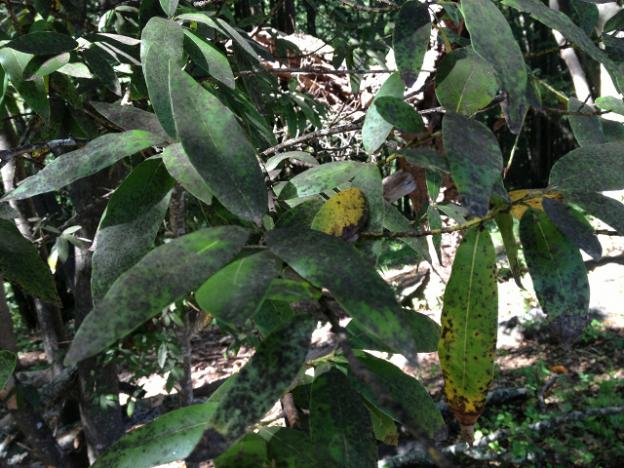
Finding bay trees in Nisene Marks proved more challenging than I anticipated, but the first one we spotted showed some foreboding signs, like a pirate cursed with the “black spot.” The normally bright green leaves displayed anemic yellow tips that ended in black blotches. Such symptoms spell bad news not for the tree itself, but for its neighboring oak trees. These splotches could harbor a tiny bugger called Phytophthora ramorum, the disease-causing water mold that gets flung from tree to tree with the help of rain.
Bay trees can blithely spread sudden oak death around to oak trees without consequence to themselves, like mosquitoes offhandedly transmitting malaria to people. Once an oak catches the disease, there’s no hope for recovery—the nearly invisible assassin penetrates the trunk and kills the tree from inside. But with some advanced warning that the disease is lurking nearby, oak lovers can take preventative action to protect their trees with a shot of chemicals.
Our goal on the SOD Blitz was to collect samples from sick-looking bay trees to fill in gaps on the researcher’s disease map. At each likely candidate, we snapped off a few of the ickiest-looking leaves, stuffed them in a manila envelope, and scribbled down the tree’s GPS coordinates. Other less devastating plant diseases can cause look-alike symptoms, so the only surefire way to test for sudden oak death is to analyze the samples in a laboratory—which is exactly what a small army of scientists and students did at UC Berkeley within 48 hours after I turned in my leaves to the event organizers.
By mid afternoon, we’d refined our “bay-dar” for picking out the trees in a leafy green lineup. Sighting each potentially diseased bay tree brought the thrill of discovery tinged with dismay—for the oaks’ sake, this is a game you don’t really want to win. We hopscotched across rocks in the creek, smiled at bikes and dogs whizzing past us on the trails, and spread the good word of the SOD Blitz to a few inquiring passersby. As we sampled one particularly impressive bay sporting a half dozen moss-covered trunks, I stared into its towering canopy far overhead. Compared to the historic grandeur of an oak, a bay tree may be considered the more “weedy” of the two. But there’s no mistaking that bays are also a majestic native species in their own right—with the unfortunate distinction of serving as highly efficient sudden oak death factories.
Come October, the UC Berkeley team will roll out the most updated version of their SOD map (www.sodmap.org), which pinpoints exactly where the disease does and doesn’t occur around the county. I’m looking forward to that day when I can zoom into the online map and retrace my walk. Whether our samples test positive or negative for sudden oak death, I can say, “That’s my data point. That’s my tree.”
Category:


