
continued from The New Big Bang Theory, Pt 2
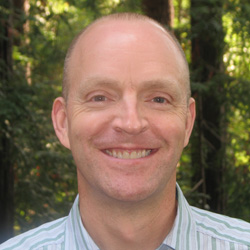 I wrote another story for Scientific American about the James Webb telescope, which will replace the Hubble telescope. It’s the next big, orbiting space observatory, an $8 billion instrument. The mirrors for that have been made at an optical lab north of Berkeley in Richmond. They had never let a reporter go see these mirrors. But I had some connections and finagled my way in there, getting special dispensation from NASA to go write this article for Scientific American. They showed me one of the hexagonal mirros. They form a honeycomb structure and unfold in space like a chrysalis. One of the hexagonal mirrors was on display. The mirror is not made of glass, but a metal, beryllium. Then they coat it with gold.
I was on the platform, looking at my reflection in this mirror, realizing, “No other reporters have seen these. No one from the general public has seen these yet.” They’re making these mirrors through this very top secret process, and I see my own reflection in a mirror that in three to four years from now will be orbiting a million kilometers from Earth, staring back at the most distant galaxies we will ever see, and collecting photons that have traveled across the universe for 13 billion years to hit that exact point on that mirror. Here I am, looking at that same mirror. And it will never be back on Earth again.
When you’re a science reporter and you feel something like that, it means something. It means you need to try to understand why you reacted in that way and you need to convey it to readers in some sort of creative way that makes sense in the narrative of the story.
Is there anything else you’d like to mention or share?
We knew this needed to be a richly illustrated story. It’s not a story you could tell through photographs alone. Right from the very beginning, the editors and I talked very intensively about how we can make the art as dynamic as possible. We were very fortunate to have Dana Berry. He’s a former NASA artist and now an independent space artist in Southern California. He took a year to develop these four illustrations. It’s an 18-page article, and eight of those pages are original artwork. I think they all came out fabulously well. I love them.
I had so much help from Rob Kunzig (my editor) to really help find the thread which made it a consistent story from beginning to end. I feel great about it.
What’s next for you?
I’m going to be in Washington, D.C. in late August. I’m going to ask for another meeting. I have a couple of really good story ideas. I don’t know what they are yet, though. But they have to be perfect. For now, I’m doing an article for Science about a group of private researchers and philanthropists called the B612 Foundation. B612 is the name of the asteroid in The Little Prince, which is a story by Antoine de Saint-Exupery, a story about a boy who lives on an asteroid. This foundation is going to be an effort to find all objects larger than about 40 meters across that could hit Earth any time within the next century. We have only found about 1 percent of such objects. The way that NASA is doing it is destined to take forever. You can’t see them from the ground. You need to go into space. The B612 Foundation is going to do it. They’re going to build the spacecraft themselves with public donations. They’re raising $400 million. It’s going to orbit in a similar orbit as Venus. It’ll find all of these objects in about six years. If any of them appear to be on a threatening impact trajectory, you can steer them away.
What’s something many people may not know about you?
My first feature article had nothing to do with astronomy. It was about siblings in the animal kingdom that kill and eat each other. The article was called “Killer Siblings.” My parents and neighbors in Vermont hated it because it was so violent. I guess this violence theme runs throughout my stories.
I play as much volleyball as I can on both the beach and the grass.
I’m turning 50 this year. I feel like I have finally hit my stride after all this time, after 25 years of being a professional writer. I feel like I finally know what I’m doing. But it took a long time to get there. There’s still a ton of struggle. Sitting down and writing this was an incredibly painful process. But that’s true for everybody. You have to embrace that as part of the creative process. That out of this pain comes this unique creation of yours. It’s not unique unless you go through that forging.
Back to The New Big Bang Theory
RELATED ARTICLES
Two Local Authors Featured in National Geographic


