
Or if the kids were visiting—my son and two daughters—we might take a drive up Highway 1 past Big Basin where the continent literally falls now and then into the sea to Ano Nuevo State Reserve and hike out over the sand dunes to view the elephant seals languishing on the beach or playing in the surf, or just walk to the end of the Municipal Pier and watch the California seals on the pilings below. Or ride the merry-go-round on the Boardwalk. Or poke around the exhibits at the Long Marine Lab at the western edge of town. Or drive an hour south to Point Lobos, below Monterey and Carmel, clamber down the rocks to the tide pools and watch for crabs as big as your thumbnails or mount the large boulders and laugh at the gamboling sea otters in the surf below and gaze toward the horizon in hope of whales.
Of all these things how much has changed, how much has stayed the same?
Above all else, the light and fog, the sea and coast remain constant. Every day of every week of every month of every year of every century of every millennium going all the way back to the eon in the geological calendar when the curve of the bay and the mountains behind it first took its current shape, the fog has rolled in, the days have dawned, the sun has passed along the southern sky and tilted down toward the western Pacific, where Bali and China lurk beneath a distant horizon.
At some point each summer I drive up the hill to the University of California campus. About six minutes from downtown Santa Cruz what may be the most beautiful campus in North America—this gathering of associated colleges, some dedicated to science, some to literature, some to social questions—stands at the edge of high meadows once used as a large grazing area for cattle and extends back into the redwood forest. When I get out of the car I turn my back to the buildings and the tall sheltering redwood trees and stare.
The view from up here lends itself to thoughts of Paradise, the curve of the bay sweeping down from the west and around to the south where the Santa Lucia Mountains rise above Monterey and Big Sur, and on the ocean horizon the low wall of fog, like some line of antique warriors regrouping after a skirmish, gathering itself for the next advance toward the coast. If I had to choose to come back in some animal form I think I would elect to become one of the high-soaring birds, gliding above the fields and forests of this campus, where deer and coyote and fox still roam in the still hours when the students are not tramping back and forth over the wooded paths and foot-bridges that connect the various colleges—and over the burnished bay.
In 1989 this Paradise shook and trembled to the tune of a 6.9 earthquake. In the aftermath of the quake, while planners and business people and townspeople debated and squabbled over the fate of the shook-up downtown, demolition teams left gaping holes that marked the end of the old Santa Cruz. Years went by before a new boutique-style Pacific Mall rose in place of the old. A multi-story mini-shopping mall replaced the hotel where the jazz band played. Chain stores arose to compete with the old Bookshop Santa Cruz for the foot traffic that comes with hundreds and hundreds of day trippers from over the hill in San Jose. Chain coffee houses and bagel shops did the same. Into the shell where the old downtown department store—absconded after the quake to a conventional mall a few miles south of downtown—once stood, moved a multiplex movie house, making initial worries for the Nickelodeon, the local art movie house. Santa Cruz, the funky old beach-comber bohemian university contrarian hippy-haven, became late-twentieth-century Americanized.
But miraculously much of the good old days remain: the book shop, the Boardwalk, the Nickelodeon, the Kuumbwa Jazz Center; and some fine new downtown restaurants along with the newly reconstituted boutique version of the old India Joze as show places for cuisine. At the beach, a newly renovated eight story hotel now overlooks the pier and the Boardwalk, and from its balconies you recognize in the great curve of the bay the mainstay of permanence here in this region of shifting tectonic plates. From that hotel doorway you can take the classic walk west on West Cliff Drive, out along toward the statue of the eponymous surfer, usually decked in garlands and leis, past Steamer Lane where the younger surfers gather to practice their sport, past the lighthouse, and then along the ocean another mile and a half or so to Natural Bridges, the constellation of large rocks at the edge of a small public beach that’s part of a state park reserve. You see seals and sea otters, an occasional pair of dolphins, and whales and multi-colored blossoming ice plants in season, the ancient pelicans flying in fleets of a dozen or more up along the coast line, and the dark cormorants diving and diving again for fish into the shimmering, swelling, rolling, sometimes ink blue, sometimes oddly lavender, sometimes deeply green ocean.. Some things—oh, lucky seeming stillness of non-geological time!—do remain the same.
Though other tectonic plates are shifting in California where the law sometimes trails human behavior and where sometimes human behavior makes for new law. As on a summer afternoon a few years ago when my older daughter got married, an event that would not have occurred in the same way, certainly not in the same place without my having taken that initial drive over the mountains all those many decades ago. On the patio behind Long Marine Lab, where the eighty-seven-foot skeleton of a blue whale looms over the parking lot, sixty of us souls, some of us local, some of us visitors, some of us in between, all the children and their sacred others, gather to celebrate a wedding. Sun and cloud play above us while the ocean roils and gathers at the base of the cliffs. Food from an expert local organic caterer. Music by an opera singer, old friend of the spouse-to-be. A cellist from San Francisco sends Bach’s notes out into the pewter shaded sky.
And as the young people make their vows, woman to woman, I know in my heart that I am wedded here too, to the place where the ink-dark sea breaks against the western rocks, my adopted home of ocean, sky, sea-bird, ice-plant, wine, music, and light, this special light.
Alan Cheuse, National Public Radio's longtime "voice of books," is the author of five novels, four collections of short fiction, and the memoir Fall Out of Heaven. As a book commentator, Cheuse is a regular contributor to National Public Radio's "All Things Considered." His short fiction has appeared in The New Yorker, Ploughshares, The Antioch Review, Prairie Schooner, New Letters, The Idaho Review, and The Southern Review, among other places. He teaches in the Writing Program at George Mason University and the Squaw Valley Community of Writers.
The Outdoor Poet is edited by Robert Sward, author of numerous books of poetry including, most recently, New and Selected Poems: 1957-2011 (Red Hen Press). He lives on the Westside with his wife, the artist Gloria Alford, and a poodle mix named Cosette. Participation in The Outdoor Poet is by invitation.
Back to The Outdoor Poet: Alan Cheuse
RELATED ARTICLES
The Outdoor Poet: Ellen Bass
The Outdoor Poet: David Sullivan
The Outdoor Poet: Charles Atkinson
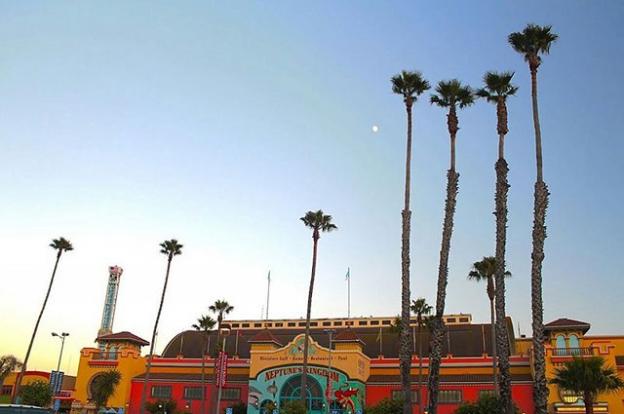
Neptune's Kingdom, Santa Cruz Boardwalk. Photo by baynk/Creative Commons.


