
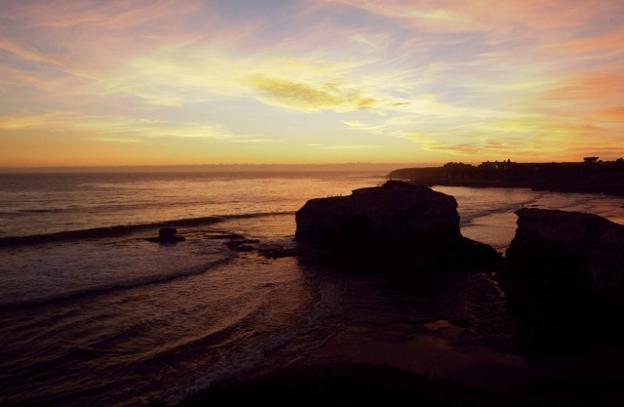
In this week's Outdoor Poet, part-time Santa Cruz local, writer and NPR commentator Alan Cheuse paints a portrait of his summertime home.
Home Away From Home in Santa Cruz
There are towns you are born into, and there are towns you grow into. Santa Cruz, California, tucked into the curve of shore at the northeast border of Monterey Bay, long ago became the latter for me.
Each June for thirty years and more I’ve been packing my bags in the hustle and bustle and humidity of the East and heading to what was once an old fishing village and beach town turned university town cooled by on-shore breezes that’s lately become a bedroom community for internet moguls from the other side of the Santa Cruz Mountains.
Though for an easterner getting here at first doesn’t seem all that easy. There are basically only two main routes in and out of town, the freeway out of San Jose that takes you on a winding thirteen mile climb into the Santa Cruz Mountains, up and over the summit on the equally winding sometimes dangerous descent from which, on a good clear day, of which there are many here, you can see the shape of the bay looming as if as a mirage on the horizon.
Or you can drive highway 1 down from San Francisco and keep the Pacific at your elbow, a drive even more dangerous than the mountain road because you often find yourself taking your eyes off the center lane and staring at the pewter of sunlight on water or the variant blues and greens and whites of ocean currents and waves.
When in the early Seventies I first arrived on this sliver of coast between the sea and the mountains, the quality of that light (that certain transparency of air that gives the impression of closing all the distance between you and sights near and far) made just about every view seem almost magical. Though, as the late James D. Houston, for forty plus years the prose master of Santa Cruz once put it, the “sea, as much as the light, gives this curve of coast its flavor…The light takes its color from the sea, sometimes seems to be emerging from it. And the sea here is ever-present…”
Located where the end of the continent breaks off and edges into that sea (and where earthquakes sometimes hasten that movement), the town back then, with forty some thousand inhabitants, had just about outgrown its origins as a fishing and retirement village even as the new campus of the University of California was stretching its wings above the great stands of redwoods in the hills to the north of downtown. The few friends I had here, mostly all fiction writers and poets, believed in the place as a haven for their best ideals—of community, of education, of a special variety of art and poetry that was thriving as I came in to town.
In those days a world-class street jazz band played at the lunch hour on the relatively new Pacific Mall—foot traffic only when it opened—and Bookshop Santa Cruz served as much as a chapel of culture as a commercial enterprise. In the downtown post office, while waiting on line, you could hear mothers and fathers wearing dreadlocks and tie-dye call to their kids Tahiti and Seahorse. Walking along the mall my son, eight years old at the time but even then a prescient young fellow bred mostly in the East and visiting for the summer, said, “Dad, can we tell the Smithsonian to save all these old hippies and put them in the museum?”
Those were good times—to borrow the title of one of Santa Cruz County’s several throw-away weekly culture guides--when after a day of writing, you could walk for an hour or so along the ocean on West Cliff Drive and recharge your soul with the beauty of the light and constantly metamorphosing surf, and then find a quiet place for an early meal and a glass of good local mountain wine, maybe at India Joze, an early Asian fusion experiment that opened in the lobby of a downtown art center. Or you could tune your ears to the expert jazz and contemporary song at a number of fine restaurants up in the foothills of the Santa Cruz Mountains. My dear late friend, the Guatemalan-born Sephardic writer Victor Perera, had a crush on the female singer in a great duo that rang harmonic changes after gourmet food in the little mountain town of Felton. (Oh, what were there names? “Oh, lost,” as Thomas Wolfe used to lament, “oh, lost! And by the wind blown…”_)
The Catalyst, a great rock and roll venue at the lower end of the mall near the beach, brought in everyone from Emmylou Harris to Leon Russell and you could stomp around on a dance floor sticky with beer and sing your heart out along with them. The Oganookie Farm Band played spirited new bluegrass, with violinist (and fiction writer) Annie Steinhart wailing away on the stage above us dancing fools. The Kuumbwa Jazz Center featured coolness, in many varieties, from an annual appearance by Mississippi-bred Long Islander Mose Allison to Hawaiian slack-key guitar. Continued
RELATED ARTICLES
The Outdoor Poet: Ellen Bass
The Outdoor Poet: David Sullivan
The Outdoor Poet: Charles Atkinson
Category:


